Wednesday, November 27, 2013

Aghamtao 22

Aghamtao: Journal of the Ugnayang Pang-Aghamtao, Inc. (UGAT) / Anthropological Association of the Philippines
Volume 22 / 2013


“Culture” and “Well-Being”

Articles

Well Being and Caring:
The Alaga system among Filipino Catholics in Brussels, Belgium
Hector Guazon, CICM

“Positibo”” Achieving well-being among young people living with HIV in Cebu City
Maria Carinnes A. Gonzales

Understanding the Ilocano concept of ‘the good life’ in the agricultural landscape of Ilocos Sur
Joy Raquel Tadeo

One River, Diverse Lives:
Why the ‘one size fits all’ approach in intervention may not work
Enrique G. Oracion

“Yuta ang Kinabuhi”, Land is Life’:
The State and the Bagobo-Klata of Sitio Kahusayan
Julienne S. Baldonado

Report from the Field

Assessing IPRA Knowledge and participation in Ancestral Domain management of the Agusanon Manobo
Marvin Doods S. De Castro

Notes on the cosmology of contemporary Agusanon Manobo in San Andres, Bunawan, Agusan del Sur

Anthropology Day 2013 Philippines

Isabelo de los Reyes as Anthropologist-at-Large
Jose Rizal and Isabelo de los Reyes: Contending models of nationhood?

Source

http://www.css.pssc.org.ph/

ISSN: 0188-4857

Tuesday, October 29, 2013

My First Experience in Joining UGAT

Director's Corner
Mussolini Sinsuat Lidasan
Al Qualam
Ateneo de Davao University

27 October 2013


On October 24 – 26, 2013 the Ateneo de Davao University’s Institute of Anthropology hosted the 35th UGAT Conference. This conference was organized by Ugnayang Pang-Aghamtao (UGAT) in cooperation with Ateneo de Davao University and Philippine Social Science Council.

The title of this year’s conference was Rethinking and Remaking Forms of Knowledge (The Critical Work of Anthropology). The conference was divided on two parts: plenary and parallel sessions. The plenary sessions had the distinguished lectures and visualizing knowledge. While the parallel sessions had the following themes: instrumentalizing knowledge, threatened knowledge systems, mining and water governance, faithful knowing and forms of life, museological tensions, cosmological turn, routes to knowing, subaltern knowledge in cities, affective knowledge, disaster and place names, and politics and poetics of knowing,

I was assigned as moderator on two parallel sessions. I will highlight only the first one, the Session B1 – Threatened Knowledge Systems. In that session, we had four presenters coming from different universities in Luzon, Visayas, and Mindanao. There were different topics and focus of their study.

The first presenter discussed reviving kinutiyan. Ms. Analyn Salvador – Amores, from UP Baguio, was the presenter. She said, “The kinutiyan is a renowned funerary blanket used by the affluent class in the Cordillera region north of Luzon and one of the national cultural treasures of the Philippines, unfortunately scarce research and documentation have been made on the blanket and its use.” She also added that, “earlier woven by the Isinay of Nueva Vizcaya, the blanket had translocal connections through trade and ritual use among the different ethnolinguistic groups in the Cordillera region (“Igorots”) in the past, and in the contemporary period. However, a handful of women elders who are knowledgeable about the practice had died out, and the intricate process and ikat technique have not been passed on to young generation of weavers. From this funeral blanket, she then connect it to the IPRA saying that the law, as a modality of understanding the peculiarities of the indigenous people has become an enabling instrument for the ethnic communities to a renewed appreciation of their culture, and a strategy to re-signify their identity.

The second presenter was from University of San Carlos. She was Prof. Zona Hildegarde Amper and her paper was entitled “A Disappearing Tradition: Gapas as Textile and Medicine in Santander, Cebu. Her study seeks to document local knowledge on “gapas” as crop, textile and medicine in this town in order to determine its place in Santander culture and recommend steps for the revitalization of an important heritage of this town.

The third presenter was Robert Panguiton from Ateneo de Zamboanga University. His paper focused on the Bajaus in Maluso and Lantawan municipalities of Basilan.  Using a qualitative method, he tried to answer a basic question: how do the Bajau indigenous laws interplay with the formal laws of the Philippines? His paper showed that on recent times, “the panglima and the Bajau constituents in many areas of Maluso and Lantawan, Basilan, continue to maneuver within the local government politics.  Many of the state laws were adapted by the Bajaus, while trying to maintain their other customary laws”. He further added that the “Badjaos made some adjustments of allowing them for enculturation of local state politics and engender greater political participation therein because they know what modern time brings where there is cultural pluralism and globalization”.

The last presenter in that session was Aidel Paul G. Belamide from the Municipal Government of Silang, Cavite. He used the theories on Cultural Materialism by Marvin Harris and Social Negotiation by Elizabeth Brumfiel, to explore the changing notions and values of land in his locality.

I consider myself very fortunate to participate and be part of the UGAT Conference. I have learned a lot. It is very much related to my line of work in Al Qalam Institute of the Ateneo de Davao University. This institute is part of the university that focuses on research and formation, inter-religious and intra faith dialogue.

One of the leading anthropologists of our time is Brother Karl Gaspar. He had written a number of books pertaining to Mindanao and the indigenous peoples. Bro. Karl is one of the pioneer members of UGAT. During the conference, he provoke my mind and spirit to write on several things. Starting from day one, Brother Karl inspired to me to write the anthropology of Islam in Mindanao. Now, what do I mean by saying this? Well, anthropology has a different lens in looking at what Islam is and the theory of liberation in the eyes of mudjaheeden. Specially in the lens of the late Chairman Hassim Salamat. Also, what is folk Islam and how do the panditas cope up in changes of our time? What is the mapping of the different schools of thought of Islam in Mindanao and what are its implication in the peace and security in Mindanao? Thus, there were so many research agenda, so many interesting topics for Al Qalam and Al IQRA.

One thing I can never forget during the conference was when I witnessed how anthropologists really interpret and define culture. Is it the practice or the idea or concepts behind the reason why people do certain acts of their norms and traditions? I was “star struck”, like a child’s first experience of watching 3D or an IMAX… different theories about culture, language, nuances, and syncretism filled our minds while listening to the presentations and open forum. At one point, I forgot that I was the moderator of the session and not a participant.

I cannot wait for the next UGAT conference. The next conference is set on 2014 in Baguio. Hopefully, by that time I can also present a paper about Islam in Mindanao for non Muslims to understand that Islam in Mindanao is diverse and very colorful.

http://alqalam.addu.edu.ph/directors-corner/my-first-experience-in-joining-ugat/

Thursday, October 24, 2013

UGAT 35th Annual Conference

UGAT 35th Annual Conference
Rethinking and Remaking Forms of Knowledge
The Critical Work of Anthropology

24-26 October 2013
Ateneo de Davao University


UGAT 35th Annual Conference - Book of Abstracts

UGNAYANG PANG-AGHAMTAO, INC. (UGAT)
Anthropological Association of the Philippines

35th Annual Conference
RETHINKING AND REMAKING FORMS OF KNOWLEDGE:
THE CRITICAL WORK OF ANTHROPOLOGY
24-26 October 2013
Ateneo de Davao University, Davao City

BOOK OF ABSTRACTS 


UGAT 35th Annual Conference BOA - download here.

Tuesday, May 21, 2013

UGAT 35th Annual Conference Call for Papers

Dear Colleagues,

Please find below the Call for Papers for  upcoming 35th Annual Conference at the Ateneo de Davao University, Oct 24-26 2012, with the theme  “Rethinking and Remaking Forms of Knowledge: The Critical Work of Anthropology”.   We hope that you can share this information to any of your friends and colleagues who may be interested in participating.

The UGAT 2013 Conference Secretariat


CALL FOR PAPERS

UGNAYANG PANG-AGHAMTAO, INC. (UGAT)
Anthropological Association of the Philippines

35th Annual Conference
RETHINKING AND REMAKING FORMS OF KNOWLEDGE: THE CRITICAL WORK OF ANTHROPOLOGY
24-26 October 2013
Ateneo de Davao University
Davao City


What counts as "knowledge"? At once destabilizing the prevailing hegemony of "science" as the paramount legitimate knowledge, this question leads us to pay serious attention to other forms of knowledge, which, in the dominant scheme of knowledge production, have been "silenced." Other related issues come to the fore: For what purposes are forms of knowledge deployed? For whom? By whom? Against whom? And with what ramifications? These issues call our attention to the need to respond to myriad ways that different stakeholders advance forms of knowledge to achieve certain ends, and to their moral and ethical underpinnings. The task is to examine why such actions are often taken for granted, despite their far-reaching consequences for the well-being and sustainability of Planet Earth, including the diverse life forms (read biocultural diversity) that dwell in it.  

UGAT welcomes panel and paper submissions that are aligned with this year's conference theme.  It hopes to generate interdisciplinary submissions that follow the lead of the "critical practice" (read questioning and reflexive) of anthropologists in engaging issues that have profound effects on the diverse publics they serve, especially those that continue to grapple with the work of structural power (read political, economic, social, and cultural forces) that shape the development and course of (indivisible) culture-nature. 

Suggested topics include, but are not limited to, the following:
  • Anthropology as science
  • Cultures of science 
  • Anthropology as advocacy, activist research, cultural critique
  • The production and deployment of “expert knowledge” in public policy: education, diplomacy, heritage and nation-building, law and order, health, population, food security, and communication, and so forth. 
  • Religious Frameworks, Political Engagement, and Public Agendas
  • Appropriations of Indigenous knowledge and practices (IKSPs), Free and Prior Informed Consent (FPIC), and Intellectual Property Rights
  • Local knowledges and moral worlds
  • The cultural politics of “evidence”
  • Ethics in propriety research and corporate social responsibility
  • Queering knowledge
  • Knowledge and cyberethnography
  • Communicating or transmitting knowledge: Proxies and Processess
  • Replicas and reproduction of knowledge:  the role of the museum
  • Issues in the ‘revival’ or revitalization of vanishing knowledge systems
GUIDELINES ON ABSTRACT SUBMISSIONS
  1. Abstracts should be 250 words and should be written in a style that is accessible to non-academic audiences. The topical area into which the abstract falls may also be indicated.
  2. Submissions should include the author’s name, institutional affiliation and complete contact information (e-mail address, telephone number, and mailing address).
  3. Please send abstracts to ugat.conference@gmail.com by 15 July 2013.
  4. Students intending to join the Student Paper Competition must indicate this in their submission. The winning entry will automatically be considered for publication in the Aghamtao, the official journal of UGAT.
For other inquiries, please contact the UGAT Conference Secretariat at +63 920 9823179 (Eizel Hilario) or + 63 0906 2285977 (Lauren Villarama) or ugat.conference@gmail.com.

Monday, December 10, 2012

Aghamtao 22 - Call for Submissions

Dear Paper Presentors at the 34th UGAT National Conference on "Culture" and "Wellbeing"

The Editorial Board of AghamTao invites you to submit your paper for consideration in the official journal of the Ugnayang Pang-AghamTao, Inc.  AghamTao is a peer-reviewed journal; all submissions are screened by the Editorial Board, and then undergo a double-blind review process.  The regular issue is launched in October and is one of the benefits of membership in the UGAT.

We would encourage you to first revise your papers especially in light of any feedback or new insights that may have been derived from the conference presentation.  Articles should be accompanied by an abstract of not more than 250 words.  The minimum length for article submissions is 3,000 words.  For referencing style please consult previous issues of AghamTao (Vols. 16-21). 

Please send article submissions in MS Word .doc format to both the following emails: maria.mangahas@gmail.com, ugat.conference@gmail.com. Please write "AghamTao Vol. 22 Submission" on the subject line.

The deadline is February 20, 2013 or sooner. Authors will be informed about the evaluations from the reviewers by March-April 2013. 

Tuesday, November 27, 2012

Aghamtao 21

Aghamtao: Journal of the Ugnayang Pang-Aghamtao, Inc. (UGAT) / Anthropological Association of the Philippines
Volume 21 / 2012


Agham Taong Kaagapay:
Anthropology Cares for its Publics

Articles 

Engaging with the OFW’s in Hongkong: How was it public anthropology?
Enrique G. Oracion

Playing with money, gambling with life: Mahjong and cardgames in the “Looban” Mlang North Cotabato
Maria Stella R. Salazar

The Appropriation of Anthropology in Market Research: Dilemmas and possibilities of an Asian practitioner
Pamela Gloria Cajilig

Training Iraya Mangyan community working groups in ethnography: Anthropology and the CADT process
Diana Josefa O. San Jose

Tungo sa kultura ng pakikisangkot Isang Pagninilay sa Pagpapalakas ng Katutubong Lente ng Antropolohiya
Jane DC. Austria-Young

Reflections on the recently concluded peace accord among the Banwaons of Agusan del Sur
Maria Easterluna S. Canoy

Source

http://www.css.pssc.org.ph/

ISSN: 0188-4857

Saturday, September 8, 2012

Agta Cimaron Agta Tabangnon of Donsol

September  8, 2012

UGNAYANG PANG-AGHAM TAO, INC.

To whom it may concern,

Good day!

I am a nephew of Milagros Tonga Musa or "lola lagring" (as many addressed her) from Dancalan, Donsol, Sorsogon one of the members of your respected association way back 1980's according to her. She became one of the researchers during her time when she was with your association. I am glad and proud when I have learned that she also contributed her studies and researches that was sponsored by your association here in Bicol. She authored the book "Agta Cimaron Agta Tabangnon of Donsol" in 80's respectively ( my apology if I don't give the exact title). At present, she is still an active chieftain here in Bicol. Since her personal copy of her book was lost many years ago by a certain agta member here in Bicol, she was really upset and dissapointed of its lost. I saw her eagerness and willingness to have a copy again of her book that is why I don't waste a time writing you about this. I would like to help my "auntie" have a copy of the book again. Now that she was around 60 years old I want her to be happy and this is the only way I believe would make her really happy.

With full of hope that my wish would be granted with the help of this e-mail, it is our pleasure if you give us another copy and recognize her as a member whom once gave a big contribution to your association and to the agta community as well.

God bless and more power!

Respectfully yours,


Hilda T. Nacion
nephew

Monday, July 9, 2012

UGAT 34th Annual Conference CFP and Registration & Accommodation Details

CALL FOR PROPOSALS

UGNAYANG PANG-AGHAMTAO, INC. (UGAT)
Anthropological Association of the Philippines

in partnership with

University of San Carlos (USC), Cebu City
Philippine Social Science Council (PSSC)

34th Annual Conference
"CULTURE" AND "WELL-BEING": CONCEPTUALIZATIONS, APPROPRIATIONS, IMPLICATIONS
25-27 October 2012
University of San Carlos, Cebu City


Dear UGAT Community,

We are pleased to announce the Call for Proposals for our 34th Conference, along with registration details and a list of hotels in close proximity to our conference host for this year, The University of San Carlos.  We would appreciate if you could pass this information along to your own relevant circles.

Thank you and we look forward to seeing you in October!


The UGAT Secretariat

-----  -----  -----  -----  -----

6 July 2012

Dear friends and colleagues,

The attainment and promotion of “well-being,” couched in various terms, has always been the default goal in a range of initiatives focused on human amelioration and social transformation.  Over the years, there has been a proliferation of culturally constituted constructions and indices of “well-being” propounded by certain public, private, and religious institutions.  This engenders the question of how responsive and responsible these conceptualizations and appropriations are in relation to the sensibilities and needs of communities in whose lives these entities intervene. As well, this question provokes ethical and practical concerns that anthropologists and related practitioners must address.

This year’s conference will have paper and panel proposals that will generate analyses and insights that critically engage processes and outcomes associated with the multiple ways by which “well-being” is construed and deployed in actual initiatives, keeping in mind the tensions and contradictions that these inevitably generate.  Of interest to this conference would be ethnographic contributions, that flesh out actual engagements with the different sectors in Philippine society, such as the fisher folks, organized labor, women, indigenous peoples, informal settlers, differently-abled persons, senior citizens, youth, LGBT, among others.   It should be noted that this conference fundamentally negates the false dichotomy between academic and applied orientation of ethically engaged anthropological practice.

In view of this, we would like to invite you to this year’s conference with the theme “Culture” and “Well-Being”: Conceptualizations, Appropriations, Implications on October 25-27, 2012, at the University of San Carlos (Main Campus), Cebu City. 

REGISTRATION DETAILS 

The registration for the conference will be on-site (specific venue to be announced), at the Main Campus of the University of San Carlos,  P. del Rosario St., Cebu City.

  • The registration fee is PhP 2,500 (PhP 2,250 for non-presenting students) to cover the conference kit and meals (lunch and snacks).
  • Graduate and undergraduate students who are presenting papers are given a reduced fee of 50% (PhP 1,250).
  • Non-student presenters and regular participants may also register early and avail of the “early bird” fee of PhP 1,800 (until 12 October 2011). Please deposit the amount to the “Ugnayang Pang-Aghamtao, Inc.” CA 00-275-830432-1 at the Philippine National Bank (PNB) (UP Campus Branch). Make sure to bring and present the deposit slip during conference registration.

Travel and accommodation expenses will not be covered by the conference organizers, and interested participants are advised to make their own reservations.  We have included a list of accommodation options with this letter.

Should you have queries, please do not hesitate to contact the UGAT Secretariat at 0906-2285977 (Ms. Lauren Villarama)/0917-6321706 (Ms. Pamela Cajilig) or e-mail address ugat.conference@gmail.com.

Thank you very much and we hope to see you in Cebu City.


Sincerely,(signed)


Eufracio C. Abaya, Ph.D.
President


Rozanno E. Rufino
Executive Director
Ugnayang Pang-AghamTao, Inc.

Thursday, April 26, 2012

UGAT 34th Annual Conference Call for Papers

CALL FOR PAPERS

UGNAYANG PANG-AGHAMTAO, INC. (UGAT)
Anthropological Association of the Philippines

in partnership with

University of San Carlos (USC), Cebu City
Philippine Social Science Council (PSSC)

34th Annual Conference
"CULTURE" AND "WELL-BEING": CONCEPTUALIZATIONS, APPROPRIATIONS, IMPLICATIONS
25-27 October 2012
University of San Carlos, Cebu City


The attainment and promotion of "well-being," couched in various terms, has always been the default goal in a range of initiatives focused on human amelioration and social transformation. Over the years, there has been a proliferation of culturally-constituted constructions and indices of "well-being" propounded by certain public, private, and religious institutions. This engenders the question of how responsive and responsible these conceptualizations and appropriations are in relation to the sensibilities and needs of communities in whose lives these entities intervene. As well, this question provokes ethical and practical concerns that anthropologists and related practitioners must address.

This year's conference invites paper and panel proposals that will generate analyses and insights that critically engage processes and outcomes associated with the multiple ways by which "well-being" is construed and deployed in actual initiatives, keeping in mind the tensions and contradictions that these inevitably generate. Of interest to this conference would be ethnographic contributions that flesh out actual engagements with the different sectors in Philippine society, such as the fisherfolks, organized labor, women, indigenous peoples, informal settlers, differently-abled persons, senior citizens, youth, and LGBT, among others. It should be noted that this conference fundamentally negates the false dichotomy between academic and applied orientation of ethically-engaged anthropological practice.

Some suggested topical areas:

  • Poverty Reduction
  • Peace and Conflict Resolution
  • Women's Welfare and Empowerment
  • Health and Caregiving (e.g., older people, differently-obied, children, people with chronic illness)
  • Care for the Environment
  • Disaster Relief and Rehabilitation
  • Migrant Workers' Welfare
  • Citizenship (social, political, economic, cultural, sexual, etc.)
  • Consumer Rights and Welfare
  • Indigenous Rights and Ancestral Domain Management
  • Teachers' and/or Students' Rights and Welfare
  • Workers' Rights and Welfare
  • Health and Workplace
  • Creativity and Artistic Expression
  • Development Policies and Programs

As in the previous UGAT conferences, paper and panel proposals that lie outside the conference theme, especially those coming from practitioners in the other subfields of anthropology, are welcome and will be considered under the rubric "Special Topics."

GUIDELINES ON ABSTRACT SUBMISSIONS

1. Abstracts should strictly be not more than 250 words, 12 font size.
2. Authors must indicate the topical area in which their paper /panel proposals may fall.
3. Abstracts should be written in a style that is accessible to non-academic audiences.
4. Submissions should include the author's name, institutional affiliation and contact information (e-mail address, telephone number, and mailing address).
5. Abstracts should be sent to ugat.conference@gmail.com by 15 AUGUST 2012.
6. For students, please indicate your intent to join the Student Paper Competition. The best entry will be considered for publication in the Aghamtao, the official journal of UGAT.
7. For other inquiries, please contact the UGAT Conference Secretariat at +63 9062285977 (Ms. Lauren Villarama) or e-mail address ugat.conference@gmail.com.

www.ugat.org.ph

Monday, November 28, 2011

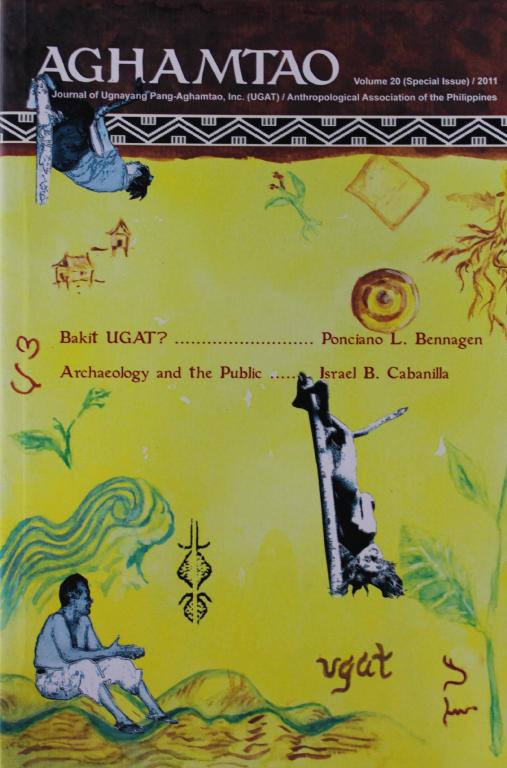
Aghamtao 20 (Special Issue)

Aghamtao: Journal of the Ugnayang Pang-Aghamtao, Inc. (UGAT) / Anthropological Association of the Philippines
Aghamtao 20 (Special Issue) / 2011


Articles

Bakit UGAT?
Ponciano L. Bennagen

Archaeology and the Public
Israel B. Cabanilla

Mga Apendise
Mga piling larawan ng mga nakalipas na kumperensya ng Ugat

Talaan ng mga kalahok, Unang Kumperensya ng UGAT (1978)

Source

http://www.css.pssc.org.ph/

Sunday, November 27, 2011

Aghamtao 20

Aghamtao: Journal of the Ugnayang Pang-Aghamtao, Inc. (UGAT) / Anthropological Association of the Philippines
Volume 20 / 2011


Articles

Disenfranchisement qua paternalism: The non-Christian fiefdom of the United States in the Philippine Islands
Owen J. Lynch

The ‘gifts of the weaver’ and their becoming at the turn of the 21st century
Nicole Revel

The Catandunganons: making and seeing selves through the eye of the typhoon
Ramon Felipe C. Pasilan

Hinangan Bajau products: Samal-Bajau cultural creativity and preservation amidst ecological crisis
Robert V. Panaguiton

Pag-abyad sa altaran: Caring for the rice terraces in Tayabas, Quezon
Kathleen D. Tantuico

Transformations in Ibaloi gold extraction from the protohistoric period to the current era (14th c.-20th c.)
Michael Armad Paredes Canilao

Report from the field: Helping the Yapayai of Ilocos Norte to secure a Certificate of Stewardship – a case study of advocacy in anthropology

Ben J. Wallace

Download Articles Here:

http://116.50.242.171/PSSC/index.php/agt01/issue/view/310

http://lynchlibrary.pssc.org.ph:8081/handle/0/3521

Source:

http://www.css.pssc.org.ph/

Tuesday, November 22, 2011

Aghamtao 21 - Call for Papers

Dear Paper Presentors at the 33rd UGAT National Conference: "AghamTaong Kaagapay:  Anthropology cares for its Publics",

The Editorial Board of AghamTao invites you to submit your paper for consideration in the official journal of the Ugnayang Pang-AghamTao, Inc.  AghamTao is a peer-reviewed journal; all submissions are screened by the Editorial Board, and then undergo a double-blind review process.  The regular issue is launched in October and is one of the benefits of membership in the UGAT.

We would encourage you to first revise your papers especially in light of any feedback or new insights that may have been derived from the conference presentation.  Articles should be accompanied by an abstract of not more than 250 words.  The minimum length for article submissions is 3,000 words.  For referencing style please consult previous issues of AGHAMTAO (Vols. 16-20). 

Please send article submissions in MS Word .doc format to both the following emails: maria.mangahas@gmail.com, ecabaya.upd@gmail.com and cc aghamtao@ugat.org.ph.

The deadline is January 30, 2012 or sooner. Authors will be informed about the evaluations from the reviewers at the end of February.

Please also fill in and send the attached author certification form.

Thank you very much!


Eufracio Abaya and Maria Mangahas
Vol.21 AghamTao Issue Editors

Tuesday, July 26, 2011

UGAT 33rd Annual Conference Call for Papers - Extended Deadline: August 15

CALL FOR PAPERS

UGNAYANG PANG-AGHAMTAO, INC. (UGAT)
Anthropological Association of the Philippines

in partnership with

Central Mindanao University (CMU)
Philippine Social Science Council (PSSC)

33rd Annual Conference
AGHAMTAONG KAAGAPAY: ANTHROPOLOGY CARES FOR ITS PUBLICS
20-22 October 2011
Central Mindanao University, Musuan, Bukidnon


Anthropologists here and abroad have increasingly recognized the urgent need to make anthropological knowledge not only accessible but also instructive to the wider publics to which it should be accountable. This is in part a way to dispel the stereotypical view that anthropologists are simply preoccupied with esoteric, distant, and exotic topics.

Over the years, UGAT has, through its annual conferences and other special projects, managed to set the stage for multi-sectoral participation in the discussion of compelling social, including political and economic, and cultural issues affecting Philippine society. We realize, however, that making anthropology deeply-engaged and relevant in the public interest arena has not been systematically assessed and may leave much to be desired. Anthropologists have yet to actively forge a theory and practice of public anthropology aimed principally at non-academic audiences, one that upholds the transformative potentials of anthropological knowledge.

We have to begin to ask how the current engagement of anthropologists in the public arena through rights-based advocacy, policy-making, institution building, media presence (e.g., television interviews, writing regular newspaper columns), signing in public statements and manifestos, conducting impact assessments, managing museums and cultural events, blogging, and other means of participating in the public sphere, have contributed to the practice of public anthropology in the Philippines that is simultaneously constructive, collaborative, and ethical.

This year’s conference invites paper and panel proposals that will generate innovative analyses and insights into the following topical areas:
  • Commentaries on current participation of anthropologists and related practitioners in the public arena
  • Development of processes and strategies towards greater visibility of anthropology and anthropologists in the public sphere
  • Ways towards ethical collaborative engagements and critique between anthropologists and their publics (e.g., indigenous peoples, migrant communities, media practitioners, policy-makers, government officials, educators, health practitioners, legislators, lawyers, corporate groups, donors, dealer of artefacts, curators, and other interest groups)
  • Constructive and collaborative anthropological engagements in knowledge production, application, and dissemination (e.g., census, social policy and program development, public health, disaster management, education, heritage conservation, environmental and social impact assessments)
  • Critical reflections on rights/social justice-based community partnerships (e.g., issue-oriented mobilization, community-based development planning, and anthropologist-local actor co-authorship in knowledge production)
The conference welcomes paper proposals addressing issues outside the conference theme for consideration under a session on special topics.

GUIDELINES ON ABSTRACT SUBMISSIONS
  1. Abstracts should strictly be no more than 250 words.
  2. Authors must indicate the topical area in which their paper/panel proposals may fall.
  3. Abstracts should be written in a style that is accessible to non-academic audiences.
  4. Submissions should include the author’s name, institutional affiliation, and contact information (e-mail address, telephone number, and mailing address).
  5. Abstracts should be sent to ugat.conference@gmail.com by 15 AUGUST 2011.
  6. For students, please indicate your intent to join the Student Paper Competition. The best entry will be considered for publication in the Aghamtao, the official journal of UGAT. 
  7. For other inquiries, please contact the UGAT Conference Secretariat at 0917-8452788 (Ms. Acel German)/0906-2285977 (Ms. Lauren Villarama) or e-mail address ugat.conference@gmail.com.
Please visit www.ugat.org.ph

[Poster in PDF attached.  You may also view / download the PDF file at this link:  http://bit.ly/e1oKbm]

Sunday, June 19, 2011

UP Anthropological Society

UP ANTHROPOLOGICAL SOCIETY


A Brief History

The society had its beginnings during the first semester of 1963-64, when Dr. Mario Zamora, Chair man of the Department of Anthropology, and seven anthropology majors sat together and informally organized, an association for anthropology students.

During the first semester of the next school year, the UP Anthropological Society was formally founded and was recognized by the UCCSOA two months after its formal organization. From a nucleus of anthropology majors, the society extended its membership to students of other disciplines who are interested in anthropology.

OBJECTIVES

A. To promote on exchange of ideas and experiences of anthropological interest among the members of the society and to foster closer ties among them.

B. To generate and promote a better understanding and interest in the science of anthropology among other students and faculty members of the university.


From:

Celebrating the Birth and Rebirth of the U.P. College of Liberal Arts (1910-1983). Published 2011 by The U.P. College of Arts and Sciences Alumni Foundation (UPCASAF), Inc.