Thursday, April 26, 2012

UGAT 34th Annual Conference Call for Papers

CALL FOR PAPERS

UGNAYANG PANG-AGHAMTAO, INC. (UGAT)
Anthropological Association of the Philippines

in partnership with

University of San Carlos (USC), Cebu City
Philippine Social Science Council (PSSC)

34th Annual Conference
"CULTURE" AND "WELL-BEING": CONCEPTUALIZATIONS, APPROPRIATIONS, IMPLICATIONS
25-27 October 2012
University of San Carlos, Cebu City


The attainment and promotion of "well-being," couched in various terms, has always been the default goal in a range of initiatives focused on human amelioration and social transformation. Over the years, there has been a proliferation of culturally-constituted constructions and indices of "well-being" propounded by certain public, private, and religious institutions. This engenders the question of how responsive and responsible these conceptualizations and appropriations are in relation to the sensibilities and needs of communities in whose lives these entities intervene. As well, this question provokes ethical and practical concerns that anthropologists and related practitioners must address.

This year's conference invites paper and panel proposals that will generate analyses and insights that critically engage processes and outcomes associated with the multiple ways by which "well-being" is construed and deployed in actual initiatives, keeping in mind the tensions and contradictions that these inevitably generate. Of interest to this conference would be ethnographic contributions that flesh out actual engagements with the different sectors in Philippine society, such as the fisherfolks, organized labor, women, indigenous peoples, informal settlers, differently-abled persons, senior citizens, youth, and LGBT, among others. It should be noted that this conference fundamentally negates the false dichotomy between academic and applied orientation of ethically-engaged anthropological practice.

Some suggested topical areas:

  • Poverty Reduction
  • Peace and Conflict Resolution
  • Women's Welfare and Empowerment
  • Health and Caregiving (e.g., older people, differently-obied, children, people with chronic illness)
  • Care for the Environment
  • Disaster Relief and Rehabilitation
  • Migrant Workers' Welfare
  • Citizenship (social, political, economic, cultural, sexual, etc.)
  • Consumer Rights and Welfare
  • Indigenous Rights and Ancestral Domain Management
  • Teachers' and/or Students' Rights and Welfare
  • Workers' Rights and Welfare
  • Health and Workplace
  • Creativity and Artistic Expression
  • Development Policies and Programs

As in the previous UGAT conferences, paper and panel proposals that lie outside the conference theme, especially those coming from practitioners in the other subfields of anthropology, are welcome and will be considered under the rubric "Special Topics."

GUIDELINES ON ABSTRACT SUBMISSIONS

1. Abstracts should strictly be not more than 250 words, 12 font size.
2. Authors must indicate the topical area in which their paper /panel proposals may fall.
3. Abstracts should be written in a style that is accessible to non-academic audiences.
4. Submissions should include the author's name, institutional affiliation and contact information (e-mail address, telephone number, and mailing address).
5. Abstracts should be sent to ugat.conference@gmail.com by 15 AUGUST 2012.
6. For students, please indicate your intent to join the Student Paper Competition. The best entry will be considered for publication in the Aghamtao, the official journal of UGAT.
7. For other inquiries, please contact the UGAT Conference Secretariat at +63 9062285977 (Ms. Lauren Villarama) or e-mail address ugat.conference@gmail.com.

www.ugat.org.ph

Monday, November 28, 2011

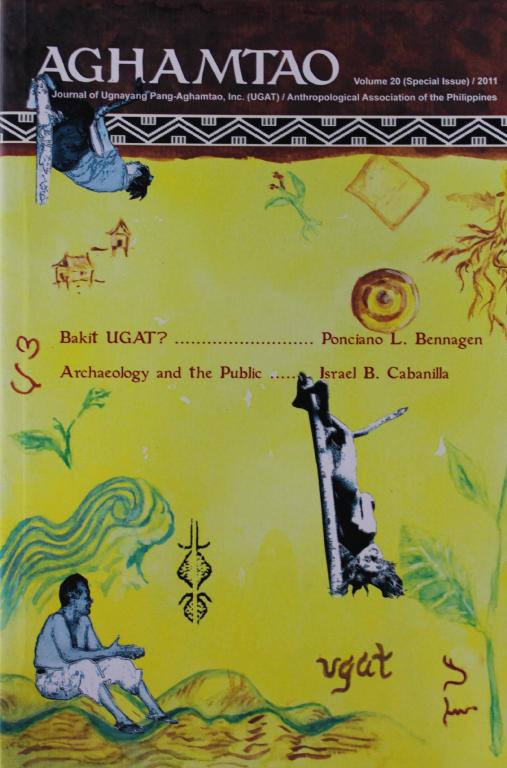
Aghamtao 20 (Special Issue)

Aghamtao: Journal of the Ugnayang Pang-Aghamtao, Inc. (UGAT) / Anthropological Association of the Philippines
Aghamtao 20 (Special Issue) / 2011


Articles

Bakit UGAT?
Ponciano L. Bennagen

Archaeology and the Public
Israel B. Cabanilla

Mga Apendise
Mga piling larawan ng mga nakalipas na kumperensya ng Ugat

Talaan ng mga kalahok, Unang Kumperensya ng UGAT (1978)

Source

http://www.css.pssc.org.ph/

Sunday, November 27, 2011

Aghamtao 20

Aghamtao: Journal of the Ugnayang Pang-Aghamtao, Inc. (UGAT) / Anthropological Association of the Philippines
Volume 20 / 2011


Articles

Disenfranchisement qua paternalism: The non-Christian fiefdom of the United States in the Philippine Islands
Owen J. Lynch

The ‘gifts of the weaver’ and their becoming at the turn of the 21st century
Nicole Revel

The Catandunganons: making and seeing selves through the eye of the typhoon
Ramon Felipe C. Pasilan

Hinangan Bajau products: Samal-Bajau cultural creativity and preservation amidst ecological crisis
Robert V. Panaguiton

Pag-abyad sa altaran: Caring for the rice terraces in Tayabas, Quezon
Kathleen D. Tantuico

Transformations in Ibaloi gold extraction from the protohistoric period to the current era (14th c.-20th c.)
Michael Armad Paredes Canilao

Report from the field: Helping the Yapayai of Ilocos Norte to secure a Certificate of Stewardship – a case study of advocacy in anthropology

Ben J. Wallace

Download Articles Here:

http://116.50.242.171/PSSC/index.php/agt01/issue/view/310

http://lynchlibrary.pssc.org.ph:8081/handle/0/3521

Source:

http://www.css.pssc.org.ph/

Tuesday, November 22, 2011

Aghamtao 21 - Call for Papers

Dear Paper Presentors at the 33rd UGAT National Conference: "AghamTaong Kaagapay:  Anthropology cares for its Publics",

The Editorial Board of AghamTao invites you to submit your paper for consideration in the official journal of the Ugnayang Pang-AghamTao, Inc.  AghamTao is a peer-reviewed journal; all submissions are screened by the Editorial Board, and then undergo a double-blind review process.  The regular issue is launched in October and is one of the benefits of membership in the UGAT.

We would encourage you to first revise your papers especially in light of any feedback or new insights that may have been derived from the conference presentation.  Articles should be accompanied by an abstract of not more than 250 words.  The minimum length for article submissions is 3,000 words.  For referencing style please consult previous issues of AGHAMTAO (Vols. 16-20). 

Please send article submissions in MS Word .doc format to both the following emails: maria.mangahas@gmail.com, ecabaya.upd@gmail.com and cc aghamtao@ugat.org.ph.

The deadline is January 30, 2012 or sooner. Authors will be informed about the evaluations from the reviewers at the end of February.

Please also fill in and send the attached author certification form.

Thank you very much!


Eufracio Abaya and Maria Mangahas
Vol.21 AghamTao Issue Editors

Tuesday, July 26, 2011

UGAT 33rd Annual Conference Call for Papers - Extended Deadline: August 15

CALL FOR PAPERS

UGNAYANG PANG-AGHAMTAO, INC. (UGAT)
Anthropological Association of the Philippines

in partnership with

Central Mindanao University (CMU)
Philippine Social Science Council (PSSC)

33rd Annual Conference
AGHAMTAONG KAAGAPAY: ANTHROPOLOGY CARES FOR ITS PUBLICS
20-22 October 2011
Central Mindanao University, Musuan, Bukidnon


Anthropologists here and abroad have increasingly recognized the urgent need to make anthropological knowledge not only accessible but also instructive to the wider publics to which it should be accountable. This is in part a way to dispel the stereotypical view that anthropologists are simply preoccupied with esoteric, distant, and exotic topics.

Over the years, UGAT has, through its annual conferences and other special projects, managed to set the stage for multi-sectoral participation in the discussion of compelling social, including political and economic, and cultural issues affecting Philippine society. We realize, however, that making anthropology deeply-engaged and relevant in the public interest arena has not been systematically assessed and may leave much to be desired. Anthropologists have yet to actively forge a theory and practice of public anthropology aimed principally at non-academic audiences, one that upholds the transformative potentials of anthropological knowledge.

We have to begin to ask how the current engagement of anthropologists in the public arena through rights-based advocacy, policy-making, institution building, media presence (e.g., television interviews, writing regular newspaper columns), signing in public statements and manifestos, conducting impact assessments, managing museums and cultural events, blogging, and other means of participating in the public sphere, have contributed to the practice of public anthropology in the Philippines that is simultaneously constructive, collaborative, and ethical.

This year’s conference invites paper and panel proposals that will generate innovative analyses and insights into the following topical areas:
  • Commentaries on current participation of anthropologists and related practitioners in the public arena
  • Development of processes and strategies towards greater visibility of anthropology and anthropologists in the public sphere
  • Ways towards ethical collaborative engagements and critique between anthropologists and their publics (e.g., indigenous peoples, migrant communities, media practitioners, policy-makers, government officials, educators, health practitioners, legislators, lawyers, corporate groups, donors, dealer of artefacts, curators, and other interest groups)
  • Constructive and collaborative anthropological engagements in knowledge production, application, and dissemination (e.g., census, social policy and program development, public health, disaster management, education, heritage conservation, environmental and social impact assessments)
  • Critical reflections on rights/social justice-based community partnerships (e.g., issue-oriented mobilization, community-based development planning, and anthropologist-local actor co-authorship in knowledge production)
The conference welcomes paper proposals addressing issues outside the conference theme for consideration under a session on special topics.

GUIDELINES ON ABSTRACT SUBMISSIONS
  1. Abstracts should strictly be no more than 250 words.
  2. Authors must indicate the topical area in which their paper/panel proposals may fall.
  3. Abstracts should be written in a style that is accessible to non-academic audiences.
  4. Submissions should include the author’s name, institutional affiliation, and contact information (e-mail address, telephone number, and mailing address).
  5. Abstracts should be sent to ugat.conference@gmail.com by 15 AUGUST 2011.
  6. For students, please indicate your intent to join the Student Paper Competition. The best entry will be considered for publication in the Aghamtao, the official journal of UGAT. 
  7. For other inquiries, please contact the UGAT Conference Secretariat at 0917-8452788 (Ms. Acel German)/0906-2285977 (Ms. Lauren Villarama) or e-mail address ugat.conference@gmail.com.
Please visit www.ugat.org.ph

[Poster in PDF attached.  You may also view / download the PDF file at this link:  http://bit.ly/e1oKbm]

Sunday, June 19, 2011

UP Anthropological Society

UP ANTHROPOLOGICAL SOCIETY


A Brief History

The society had its beginnings during the first semester of 1963-64, when Dr. Mario Zamora, Chair man of the Department of Anthropology, and seven anthropology majors sat together and informally organized, an association for anthropology students.

During the first semester of the next school year, the UP Anthropological Society was formally founded and was recognized by the UCCSOA two months after its formal organization. From a nucleus of anthropology majors, the society extended its membership to students of other disciplines who are interested in anthropology.

OBJECTIVES

A. To promote on exchange of ideas and experiences of anthropological interest among the members of the society and to foster closer ties among them.

B. To generate and promote a better understanding and interest in the science of anthropology among other students and faculty members of the university.


From:

Celebrating the Birth and Rebirth of the U.P. College of Liberal Arts (1910-1983). Published 2011 by The U.P. College of Arts and Sciences Alumni Foundation (UPCASAF), Inc.

Tuesday, June 14, 2011

Emma Balmaceda

Dear Friends,

I do hope you still remember Emma Balmaceda. She used to be Sir Pons Bennagen's assistant at SENTRO. I recieved word last June 14, 2011 that she urgently needs to undergo chemoteraphy. Any help we can extend to her will go a long way.

Emma has a savings account for donations:

Emma V. Balmaceda
307-3-30708972-7
Metrobank, Kalaw Hill

You can get in touch with her at 0919 4383560. Likewise, kindly spread the word regarding Emma B's situation.

On behalf of Emma B, maraming maraming salamat!


Tuni Balisi

Sunday, April 17, 2011

UGAT 33rd Annual Conference Call for Papers

CALL FOR PAPERS

UGNAYANG PANG-AGHAMTAO, INC. (UGAT)
Anthropological Association of the Philippines

in partnership with

Central Mindanao University (CMU)
Philippine Social Science Council (PSSC)

33rd Annual Conference
AGHAMTAONG KAAGAPAY: ANTHROPOLOGY CARES FOR ITS PUBLICS
20-22 October 2011
Central Mindanao University, Musuan, Bukidnon


Anthropologists here and abroad have increasingly recognized the urgent need to make anthropological knowledge not only accessible but also instructive to the wider publics to which it should be accountable. This is in part a way to dispel the stereotypical view that anthropologists are simply preoccupied with esoteric, distant, and exotic topics.

Over the years, UGAT has, through its annual conferences and other special projects, managed to set the stage for multi-sectoral participation in the discussion of compelling social, including political and economic, and cultural issues affecting Philippine society. We realize, however, that making anthropology deeply-engaged and relevant in the public interest arena has not been systematically assessed and may leave much to be desired. Anthropologists have yet to actively forge a theory and practice of public anthropology aimed principally at non-academic audiences, one that upholds the transformative potentials of anthropological knowledge.

We have to begin to ask how the current engagement of anthropologists in the public arena through rights-based advocacy, policy-making, institution building, media presence (e.g., television interviews, writing regular newspaper columns), signing in public statements and manifestos, conducting impact assessments, managing museums and cultural events, blogging, and other means of participating in the public sphere, have contributed to the practice of public anthropology in the Philippines that is simultaneously constructive, collaborative, and ethical.

This year’s conference invites paper and panel proposals that will generate innovative analyses and insights into the following topical areas:
  • Commentaries on current participation of anthropologists and related practitioners in the public arena
  • Development of processes and strategies towards greater visibility of anthropology and anthropologists in the public sphere
  • Ways towards ethical collaborative engagements and critique between anthropologists and their publics (e.g., indigenous peoples, migrant communities, media practitioners, policy-makers, government officials, educators, health practitioners, legislators, lawyers, corporate groups, donors, dealer of artefacts, curators, and other interest groups)
  • Constructive and collaborative anthropological engagements in knowledge production, application, and dissemination (e.g., census, social policy and program development, public health, disaster management, education, heritage conservation, environmental and social impact assessments)
  • Critical reflections on rights/social justice-based community partnerships (e.g., issue-oriented mobilization, community-based development planning, and anthropologist-local actor co-authorship in knowledge production)
The conference welcomes paper proposals addressing issues outside the conference theme for consideration under a session on special topics.

GUIDELINES ON ABSTRACT SUBMISSIONS
  1. Abstracts should strictly be no more than 250 words.
  2. Authors must indicate the topical area in which their paper/panel proposals may fall.
  3. Abstracts should be written in a style that is accessible to non-academic audiences.
  4. Submissions should include the author’s name, institutional affiliation, and contact information (e-mail address, telephone number, and mailing address).
  5. Abstracts should be sent to ugat.conference@gmail.com by 15 JULY 2011.
  6. For students, please indicate your intent to join the Student Paper Competition. The best entry will be considered for publication in the Aghamtao, the official journal of UGAT. 
  7. For other inquiries, please contact the UGAT Conference Secretariat at 0917-8452788 (Ms. Acel German)/0906-2285977 (Ms. Lauren Villarama) or e-mail address ugat.conference@gmail.com.
Please visit www.ugat.org.ph

Saturday, November 27, 2010

Aghamtao 19

Aghamtao: Journal of the Ugnayang Pang-Aghamtao, Inc. (UGAT) / Anthropological Association of the Phlippines

Volume 19 / 2010


Articles

Locating the Sacred in the City: Pilgrimage and Spirituality in Zamboanga City
Robert V. Panaguiton

(Re)Searching Identity in the Highlands of Central Panay
Mary Acell German

Invisible States, Peripheral Sites: Artistic Negotiations of the Urban
Tessa Maria Guazon

Makati as a ‘Livable City’ – Lines in Pleasant Places
Eliseo Co

BA Anthropology as a commodity choice
Maria Mangahas

Social Science in the Wider Social Field: UP Mindanao’s BASS and BAA Programs
Myfel Joseph Paluga

Book Review:

Paul W. Mathews. Asian Cam Models: Digital Virtual Virgin Prostitutes? Quezon City: Giraffe Books, 2010
Aileen Paguntalan-Mijares

Download Articles Here:

http://116.50.242.171/PSSC/index.php/agt01/issue/view/215

http://lynchlibrary.pssc.org.ph:8081/handle/0/1453

Source:

http://www.css.pssc.org.ph/


Monday, October 4, 2010

Bontoc Eulogy (1995)

Bontoc Eulogy (1995)

A very interesting re-"visiting" of the St. Louis World Fair of 1904. This makes a very good companion to Benito M. Vergara Jr's Displaying Filipinos: Photography & Colonialism in Early 20th Century Philippines. Please share the link to friends and to those who are interested (especially those who are into anthropology and ethnography).


Marlon E. Fuentes' BONTOC EULOGY is a haunting, personal exploration into the filmmaker's complex relationship with his Filipino heritage as explored through the almost unbelievable story of the 1100 Filipino tribal natives brought to the U.S. to be a "living exhibit" at the 1904 St. Louis World's Fair. For those who associate the famous fair with Judy Garland, clanging trolleys, and creampuff victoriana, BONTOC EULOGY offers a disturbing look at the cultural arrogance that went hand-in-hand with the Fair's glorification of progress. The Fair was the site of the world's largest ever "ethnological display rack," in which hundreds of so-called primitive and savage men and women from all over the globe were exhibited in contrast to the achievements of Western civilization.

The Manila-born Fuentes explores his complex relationship with his Filipino ancestry by researching the path of Markod, a Bontoc Igorot warrior brought to St. Louis in 1904, never to return home. Using historical data from the Library of Congress and the National Archives, 90-year-old archival footage, and seamless recreations, Fuentes weaves the story of the missing Markod with his own musings on the fate of his ancestral "grandfather" and the whereabouts of his final remains.

Fuentes, who serves as the film's on-screen narrator, quotes a well-known Philippine saying: "He who does not look back from whence he came from will never ever reach his destination." With BONTOC EULOGY, Fuentes has created an insightful and poignant examination of history, family, memory, and cultural loss ³ and a film that speaks to the entire immigrant experience as well as telling one truly unforgettable story.

http://www.itvs.org/external/bontoc/bontoc.index.html


Download Link:

http://www.demonoid.me/files/details/2403204/5668572/

Language: English
Country: Philippines
Color: Black and White
Runtime: 57 mins
IMDb Link: http://www.imdb.com/title/tt0199372/
Rating: 7.6/10

Director: Marlon Fuentes
Cast:
Marlon Fuentes ... Narrator
Jordan Porter ... Boy with camera
Nicole Antonia ... Girl with camera
Michael Porter ... Boy in mosquito net
Eliseo Bacolod ... Markod (ship)
Enrico Obusan ... Markod (St. Louis)
Fermina Bagwan ... Markod (voice)
Aaron Levinson ... Male announcer

Tuesday, August 24, 2010

Proposed Mindanao Panel - An Anthropology of a Marshland Community

PROPOSED PANEL– An Anthropology of a Marshland community
32nd UGAT Annual Conference

Panel Abstract

This panel features three studies conducted in an Agusan Manobo community in Brgy. Mambalili, Bunawan, Agusan del Sur. Topics such as anthropology of sago, identity assertion and agricultural rituals are weaved together by focusing on the utilization of food resources in a specific ecological niche.


[PAPER 1]

Heuristic schemas for an anthropology of sago (Metroxylon sagu) in Agusan Marsh (Agusan del Sur, Mindanao)
MJ Paluga, Department of Social Sciences, CHSS, UP Mindanao

Abstract

The paper presents key preliminary results from an anthropological study (UP-Min Anthropology Field School 2010) of sago (Metroxylon sagu) forest and its structural relation to the wider socio-geographic space of Agusan Marsh (central area of study: Mambalili, Bunawan, Agusan del Sur) and some aspects of Agusan Manobo cultural practices. The spatial links of at least three ethno-ecological areas of the Agusan Manobo domain—danao/lake, yumbia/sago forest, pasak/agricultural field—is presented as a heuristic schema that appears to inform much of the enduring livelihood patterns and rhythms of marsh-dwelling Manobos. Highlighting sago as the focal object of this specific anthropological inquiry, the paper also presents a usable approach for an "object-oriented" anthropology.


[PAPER 2]

Netibo lang ang nagakao’g unaw: producing and consuming identity among the Manobo in Bunawan, Agusan del Sur.
Jessie G. Varquez, Jr.– UP Mindanao

Abstract

The main thesis of this paper is that there is a discourse of identity formation and assertion in appropriating unaw (local name of sago starch) extracted from a lumbia (sago tree) as a survival food in a predominantly Agusan Manobo community in Bunawan, Agusan del Sur. By looking at the production, distribution and consumption of unaw in this community, the paper examines layers of narratives among the Manobo on how they view themselves as the rightful owner of the lumbia forest as part of their ancestral domain thus the right to extract sago starch and the social stigma associated in consuming the extracted sago starch. Queries on consumption, inter-ethnic relations and ecological management of lumbia forest are probed in this study.


[PAPER 3]

Taephag: A Reflection on a Manobo's Concept of Thanksgiving
Raymundo R. Pavo - University of the Philippines Mindanao

Abstract

Taephag is a Manobo ritual exercised before planting and/or harvesting. Interpreted as a spiritual activity, Taephag as an expression of thanksgiving entails a depth of complexity. In this respect, this article seeks to own this query: What is a Manobo's notion of Thanksgiving in relation to Taephag? This is the question which the present article hopes to address. As an initial thesis, we propose that in the Taephag, the Manobo's sense of gratitude is regulated by fear. While a Manobo farmer acknowledges the help of the Nature-Spirits for their permission to use the land and for protecting their crops, the Manobo is also wary that the ritual will not proceed undisturbed and as planned. This worry is based on his fear that the Nature-Spirits will later on inflict sickness/diseases on their families or be the cause of an unsuccessful future harvest. Between gratitude and fear, the Manobo, while engaged in the Taephag, tries to bracket his fear so he can focus on how the ritual should be performed. As he tries to provide a place (the ritual) where the Nature-Spirits can gather, it his sense of fear which secures his courage to persevere. Thus, it may be construed that it is this unique notion of fear which permeates a Manobo's notion of Taephag as thanksgiving.

Sunday, July 18, 2010

Re: UGAT 32nd Annual Conference

deAR DR, ABAYA (BOY);

thanks for the quick response - indeed earlier topics reflect the broad interests of the discipline. my suggestion was simply to include an open panel for those participants interested in giving papers that do not fall within the particular conf. theme. i appreciate the significance of this year's theme and look forward to the section on communication strategies since certainly the new media has been a major player in bringing global attention to issues regarding indigeneity. perhaps in the future we can discuss the links between indigeneity and globality,

raul

Saturday, July 17, 2010

Re: UGAT 32nd Annual Conference

Dear Dr. Pertierra,

Thank you for expressing your opinion on the forthcoming UGAT conference. It may interest to know that UGAT in recent years has addressed burning issues swirling around the anthropology of governance, the cities, heritage politics, and globalization. This year's conference is in solidarity with the celebration of the Indigenous Peoples' Month slated in October. Please note that one of the topics to be discussed in the conference deals with "crafting communication strategies for IP rights advocacy", which perhaps might generate interest from you.

Very truly yours,

Eufracio Abaya

Wednesday, July 14, 2010

Re: UGAT 32nd Annual Conference

dear dr. abaya & colleagues;

thanks for sending me the program for this year's conference - the topic sounds very interesting but unfortunately i am not currently working in this area. i had inquired earlier if it was possible to suggest other (broader)topics but it seems this is not possible. i accept this limitation even if it means i am unable to participate in the conference. however, from the program, a reader may get the impression that anthropologists only (or mostly) study indigenous, tribal or ethnic cultures. in fact, most anthropologists study mainstream cultures, including urban groups and even technological practices such as mobile phones and the internet. it would indeed be unfortunate if we give the general public the impression that anthropology is mainly the study of exotic peoples. this interest may have been the historic origins of anthropology but the discipline has long since expanded its research orientation, both because exotic peoples are rapidly transforming and going global and because anthropology is ultimately the study of the self (in its many manifestations) as much as, if not more than, the other. fraternal/sororal greetings from an old colleagues -

raul pertierra

UGAT 32nd Annual Conference 2nd Call for Papers

Dear colleagues,

Please find attached the 2nd Call for Papers for the upcoming Ugnayang Pang-Aghamtao/Anthropological Association of the Philippines' 32nd Annual Conference entitled "Kalikhasan in Flux: Indigenous Peoples' Creativity in a Changing Natural Environment." The deadline has been extended to August 15, 2010. Please also note the changes in date and venue. The conference will be held on October 20-23, 2010 at Manila Pavilion.

We hope you will be able to disseminate this call to your colleagues.

Thank you very much.

Sincerely,

Eufracio Abaya
Conference Convener

Rosa Castillo
Program Chair